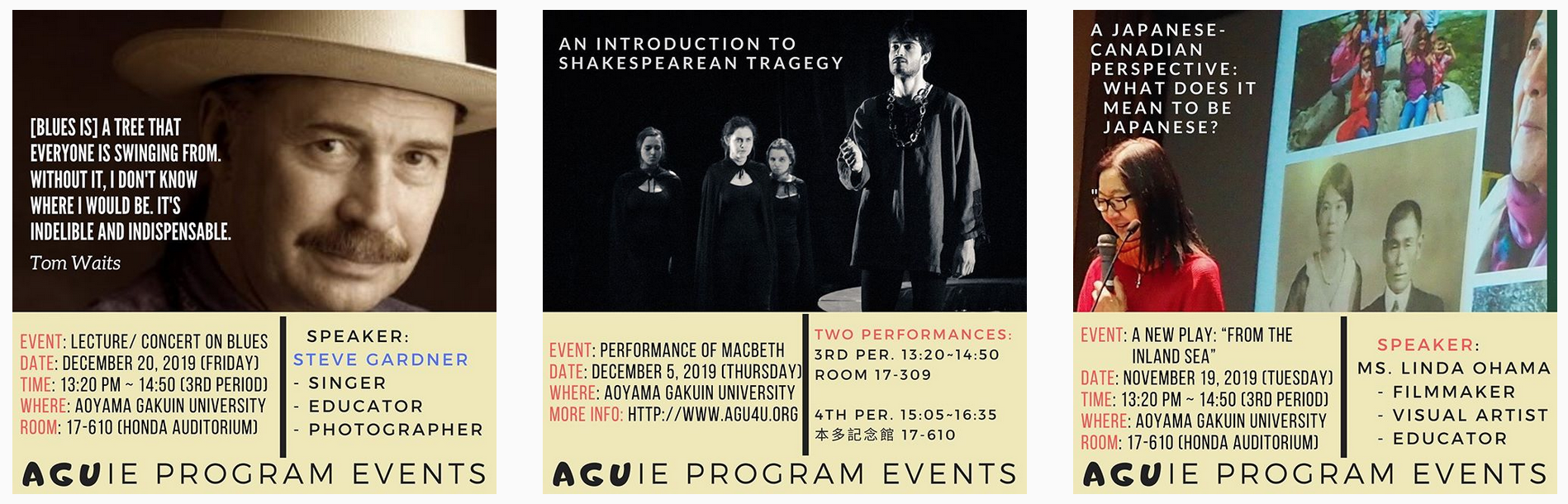

Speaker: Ms. Linda Ohama
Topic: “An Alien’s Dream: Immigrants’ Struggle for Acceptance and Belonging”
Location: Aoyama Campus, Room TBA (to be announced)
Date: Friday, December 11, 2026
Time: 1:20 PM to 2:50 PM (3rd period) [Come to the classroom early as the talk will start on time!)
We are pleased to bring back to AGU a dynamic speaker we have hosted several times in the past and whose message could not be more relevant than in today’s social and political climate. A third generation (Sansei) Japanese Canadian, Linda Ohama has worked as an exhibiting visual artist and as a documentary filmmaker.
Her talk will focus on the Japanese immigrant story, particularly those Japanese who immigrated to North America, experiencing generations of racism and rejection, but eventually becoming recognized as a vital, respected part of the rich multicultural fabric of society.
Bio: Linda Ohama is a filmmaker with an extensive history of integrating community, historical, and social justice initiatives in and around her films. She is well known for her short documentary, Watari Dori (A Bird of Passage), which was produced in the 1980s to raise funds and awareness for the Redress campaign to compensate Japanese Canadians who were unjustly treated by the Canadian government during the Second World War. Ms. Ohama was born in Alberta and grew up on a family farm, and her connection to rural life and the prairies is evident in much of her work, particularly in her early films: The Last Harvest, and Neighbours, Wild Horses and Cowboys. Ohama later moved to Vancouver, where she reconnected with her family’s roots in Steveston, undertaking the restoration of a Japanese-built fishing boat and the recreation of her grandmother’s prewar garden, the latter of which led to her film, Obaachan’s Garden. She first visited Japan in 1998, inspiring her to become involved in promoting cultural exchange between Japan and Canada. Ms. Ohama also produced and directed the documentary “Tohoku no Shingetsu”–“New Moon Over Tohoku”–which concerns the experiences of people in Tohoku during, and after, the earthquake/ tsunami/ nuclear disaster of March 11, 2011.
Linda Ohama writes:
My father was a 25-year-old student at the University of British Columbia (Vancouver) with a dream to become a lawyer one day. He was a ‘nisei’ (second generation) born in Canada. His father and mother were both born in Japan. Like any university student, he worked hard to earn his tuition and studied hard to get good grades. He was also an officer in the Royal Military Cadets for Canada.
In the spring of 1942, his dreams became a nightmare the day he was ‘kicked out’ of university and lost his right to earn a degree. Why?
The government imposed the War Measures Act to intern 21,000 Canadians of Japanese ancestry and he became an ‘enemy alien’. (The U.S. government also used a similar Alien Enemies Act in their 1942 forced internment of 120,000 American Japanese.)
Recently, the American government has used the Alien Enemies Act once again and the dreams of families, university students, and people who fled violence in their country of origin, like Kilmar Abrego Garcia, are broken.
Through my work as a documentary filmmaker, I have explored the loss of dreams caused by social and political injustices, hoping to inspire deeper understanding, advocacy for change and the hope for a better way of being. I will share some of my personal experiences and research in my presentation.
Post script:
My father received an honorary degree and formal apology from the University of British Columbia in 2012, seven years after his death. I received the degree on behalf of his dream. Today, my ‘yonsei’ daughter (my father’s granddaughter) is a practising lawyer who has earned respect for her human justice work representing the rights of marginalized women, children and groups in Canada. She also teaches law at the University of British Columbia.
Sometimes, one man’s dream takes several generations to be fulfilled.
To be even better prepared for the lecture, you may wish to download and read an article reviewing “Obachan’s Garden” that Gregory Strong contributed to the Daily Yomiuri. The article appeared on November 14, 2002, as the film was being screened throughout Japan for the first time. The article is followed by some skimming and scanning, and comprehension questions. You can watch “Obachan’s Garden” in its entirety at: https://www.nfb.ca/film/obachans_garden/. See her filmography here: https://www.ohamalinda.com/films.
Finally, it would useful for students and teachers who plan to attend the lecture to do some background reading on the internment of Japanese by the Canadian government during the war. You can check out Wikipedia’s page on Japanese internment and an entry in the Canadian Encyclopedia about the history of the Japanese in Canada.
Other articles that will help you to prepare for the talk:
‘Very dangerous’: Japanese Americans warn of Trump’s use of Alien Enemies Act
The Alien Enemies Act Paved the Way for Japanese American Incarceration. Let’s Keep It in the Past.
4 things to know about the Alien Enemies Act and Trump’s efforts to use it
Photograph showing the Murakami Visitor center in Steveston, a small community near Vancouver, the former home of Asayo Murakami (Linda Ohama’s Obachan).